


Oct 6, 2026
Press Release: Jes Crownover Joins Tru as Head of Global Trade
Former FedEx and Livingston executive joins Tru to build the trade infrastructure for the future of imports.
Event
Oct. 27th 12pm ET
 U.S. Customs and
We are adopting new technology to further advance security and revenue objectives... these solutions will increase the thoroughness and reduce the time needed overall to conduct import or entity reviews, segment risk, and reduce CBP personnel manpower and resource commitments.
CBP's mandate
Entry Building
Learn how your business can use Tru's Responsible AI the same way CBP does.
“After we switched to Tru, it has been a game changer. There are no customs rejections whatsoever.”
Agency Overview
U.S. Customs and Border Protection (CBP) is the largest federal law enforcement agency within the U.S. Department of Homeland Security, responsible for securing the nation's borders while facilitating lawful international trade and travel. CBP processes millions of import entries each year, balancing security and revenue objectives against the need to keep legitimate commerce moving.
The Challenge
The volume and complexity of import entries place significant demands on CBP personnel. Conducting thorough entity and import reviews manually is time-intensive, and critical data often arrives too late in the process to inform enforcement decisions.
4.4 million shipments arrive at the U.S. border every day for entry and must be processed by CBP, either being prioritized for inspection, referred to a Partner Government Agency (PGA), or released.
Commercial solutions like Tru Identity already support customs brokerage, 3PL, and importer workflows to audit and segment higher-risk shipments for manual intervention and correction. However, increased thoroughness of reviews requires substantial additional manpower and resource commitments.
The End Users
The end users are the front-line officers at the Office of Field OperationsOffice of Field Operations (OFO), is the largest component in CBP and is responsible for border security—including anti-terrorism, immigration, anti-smuggling, trade compliance, and agriculture protection—while simultaneously facilitating the lawful trade and travel at U.S. ports of entry that is critical to our Nation’s economy. who conduct risk assessments and make critical national security decisions, taking input from systems like the Automated Targeting System (managed by National Targeting Center), and leverage their years of experience and officer intuition to make decisions to interdict illicit, fraudulent, or other seemingly-anomalous cargo.
Our partner at CBP is the Office of Information Technology and Office of TradeThe Office of Trade (OT) consolidates the trade policy, program development, and compliance measurement functions of CBP into one office. The Office provides uniformity and clarity for the development of CBP’s national strategy to facilitate legitimate trade and manages the design and implementation of results-driven strategic initiatives of trade compliance and enforcement. It directs national enforcement responses through effective targeting of goods crossing the border as well as strict, swift punitive actions against companies participating in predatory trade practices. Through coordination with international partners and other U.S. government agencies it directs the enforcement of intellectual property rights, the identification of risks to detect and prevent the importation of contaminated agricultural or food products and the enforcement of free trade agreement eligibility. By promoting trade facilitation through partnership programs, the Office of Trade will streamline the flow of legitimate shipments and foster corporate self-governance as a means of achieving compliance with trade laws and regulations., who work tirelessly to give OFO the tooling they need to make the best decision. More data is not helpful. Rather, actionable, provenance-preserving data from a trustworthy system that produces predictable results actually move the needle. This was our mission statement.
Office of Field OperationsOffice of Field Operations (OFO), is the largest component in CBP and is responsible for border security—including anti-terrorism, immigration, anti-smuggling, trade compliance, and agriculture protection—while simultaneously facilitating the lawful trade and travel at U.S. ports of entry that is critical to our Nation’s economy. needs best-in-class tools that deliver a definitive edge, like earlier receipt of trade data and advanced Artificial Intelligence analysis of provided shipments information. Multi-tier supply chain analysis, entity investigations, automated advanced product research, and provenance-preserving case reports deliver tangible value to front-line officers.
Office of TradeThe Office of Trade (OT) consolidates the trade policy, program development, and compliance measurement functions of CBP into one office. The Office provides uniformity and clarity for the development of CBP’s national strategy to facilitate legitimate trade and manages the design and implementation of results-driven strategic initiatives of trade compliance and enforcement. It directs national enforcement responses through effective targeting of goods crossing the border as well as strict, swift punitive actions against companies participating in predatory trade practices. Through coordination with international partners and other U.S. government agencies it directs the enforcement of intellectual property rights, the identification of risks to detect and prevent the importation of contaminated agricultural or food products and the enforcement of free trade agreement eligibility. By promoting trade facilitation through partnership programs, the Office of Trade will streamline the flow of legitimate shipments and foster corporate self-governance as a means of achieving compliance with trade laws and regulations. and Office of Information Technology serve field officers by bringing them cutting edge, innovative technologies that are already delivering value in the private sector. OT/OIT relentlessly test, evaluate, and deploy new technology that improves officer intuition while enabling compliant importers to demonstrate the work they are doing to meet the demands of modern regulation.
The Policy
In June 2026, the Executive branch set a new policy agenda for trade in the United States.
Customs enforcement is essential to the national security, foreign policy, and economy of the United States... Systemic inefficiencies, loopholes, insufficient enforcement mechanisms, and outdated processes have created opportunities for malign actors to evade Federal law.
CBP is operating in a new era: One with better tools, one with more ability to deploy technology, and one where first and foremost, CBP protects the revenue and national security interests of the United States.
The ability to demonstrate your compliance to CBP is what will differentiate best-in-class importers from those who passively import. Your data has never mattered more than today, and CBP is equipped with tooling to identify risky, fraudulent, or anomalous trade.
The Solution
CBP selected Tru Identity to "increase the thoroughness" of conducting import or entity reviews and to better segment risk. By partnering with Tru, CBP can propel industry adoption of how and when customs entries are compiled and reviewed to "enable more accurate, timely entries." Per Tru's press release with CBP, Tru's solution "allows customs brokers to demonstrate responsible supervision and control over their operations while leveraging the latest technology to support their importers."
This risk segmentation, and the capabilities that augment officers' abilities is powered by Tru Responsible AI and the Tru Compliance Engine. This same technology is what powers Tru's Entry Building, available and used today by customs brokers across the United States.
Instead of writing entries by hand, or with off-the-shelf technology, Tru's proprietary Entry Building methodology uses Responsible AI so that brokers and importers create and file their entries according to the standard before it's filed or reviewed.
Tru's methodology is centered on risk management, eliminating the common trade-off of (1) speed, (2) accuracy, and (3) control. With Tru Responsible AI, customs brokers and importers can demonstrate their compliance and control over operations while using technology to speed up workflows.
Company updates, product news, and what’s happening in the world of trade straight to your inbox.
Upcoming Webinar
Oct 27, 2026
CBP enforcement is changing the cost of bad product data. See how Tru gives importers the control, visibility, and audit readiness to stay ahead.
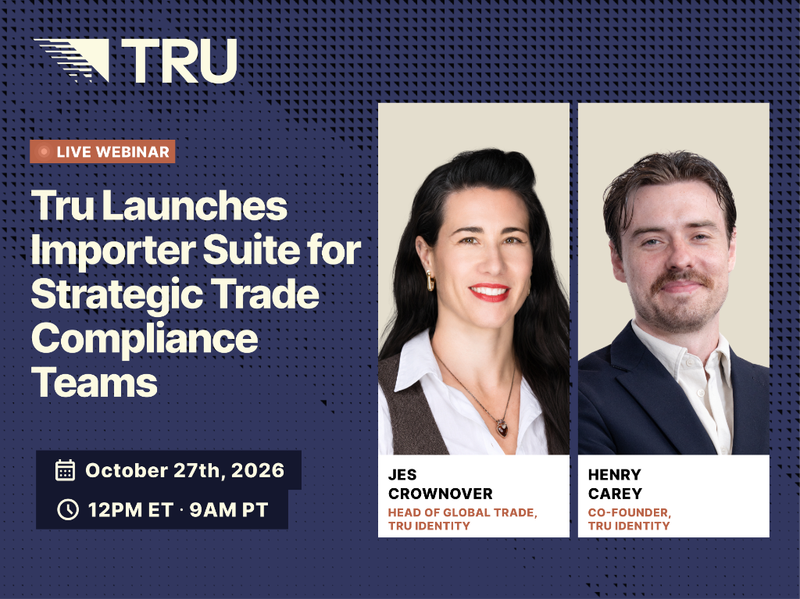
Oct 6, 2026
Former FedEx and Livingston executive joins Tru to build the trade infrastructure for the future of imports.

Oct 6, 2026
Jes Crownover discusses why trade compliance's future belongs to those who combine expertise with technology.
Sep 4, 2026
With CF-29 enforcement up 148% in Q2, "responsible supervision and control" is no longer theoretical, customs brokers need documented proof of who reviewed each entry, why they classified it that way, and which tariff rules applied at the time, or face penalties and license suspension

©2026 Tru Identity, Inc. All rights reserved.