Event
Oct. 27th 12pm ET
It is a terrible time to be a license holder
By Hugo Pakula
This post was originally published in Hugo Pakula's Trade Craft Newsletter on LinkedIn.
Q2 2026 was one of the highest periods of enforcement in U.S. Customs history. The close of the first ever continuing education triennial period is approaching. Tariffs are fluctuating constantly, and Trade Remedies are coming and going like the waves at the beach. Importer-level and brokerage-level enforcement is already under way. And CBP is equipped with $3.5 billion to increase and strengthen customs enforcement.
Leadership demands more.
Customs Brokerages are measured more closely (by leadership and by customers).
And whether you're an LCB at a customs brokerage or in a trade compliance role at an importing company, next quarter is always even more important than this quarter.
Trade-offs
Customs brokers who wish to spend their time on proactive work are spending more time with post-entry work. It is not enough to just focus on cargo release, but rather, you must deliver results for your clients and business stakeholders beyond just the shipment and contribute to overall compliance.
The underlying challenge is the increase in the amount of expected work, but very little change in terms of overall price of these trade services:
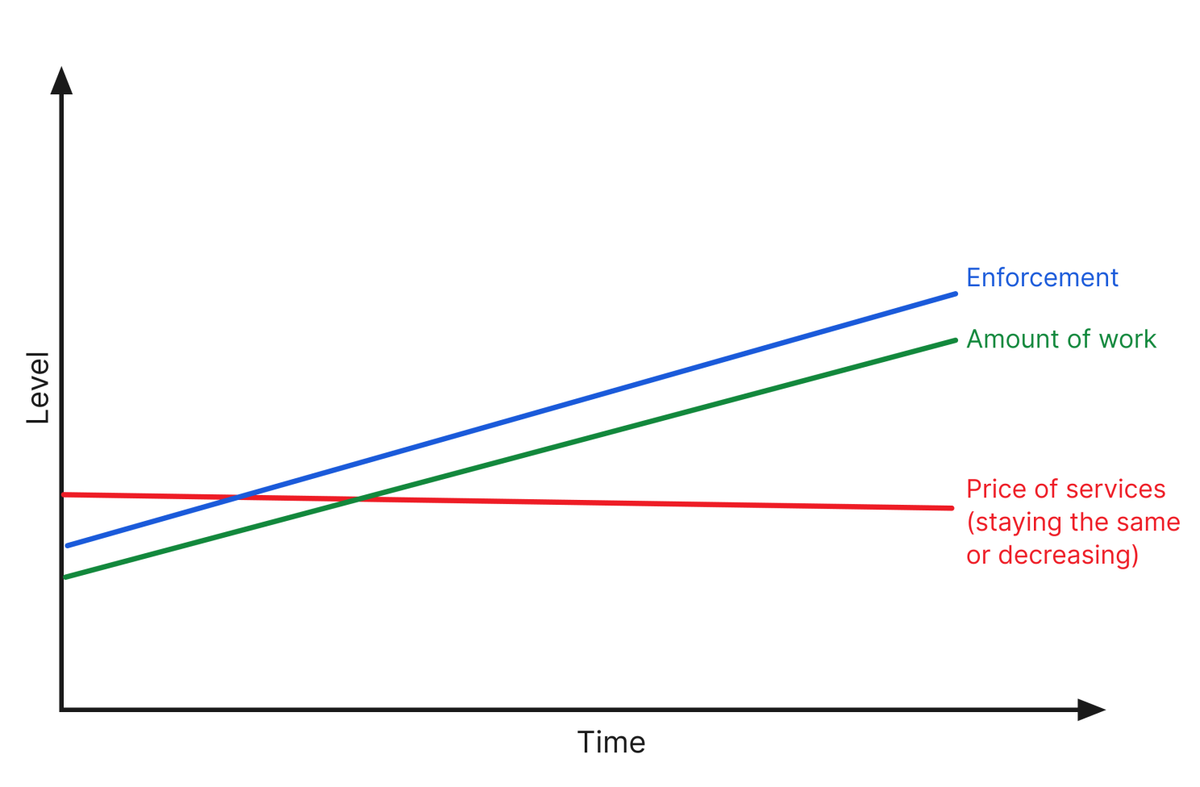
The intercept point of these lines point to something that everyone should be scared of: the death of the quality customs brokerage industry.
This intercept point is why you've seen so many technology providers come to this space. The new frontier for growing brokerages is figuring out how to make the business profitable again, while maintaining the quality of the customer experience.
The new frontier
In most industries when profitability shrinks, there is a clear path to help manage costs: offshoring.
As anyone familiar with 19 CFR is aware, this option is not available for customs business. You simply cannot (compliantly) mitigate costs with offshore labor, no matter the cost savings.
This means the driving force for reducing cost is to implement technology that gets at the root of the bottlenecks for this industry:
- Speed (how much throughput can our operational resources manage?)
- Accuracy (how 'complete' and 'defensible' are the outputs from the Ops team?)
- Control (how well can the process be supervised and thus compliant per 19 CFR 111.28?)
Does technology address the gaps (yet)?
Every broker I hear from asks many of the same questions, much along the lines of "Can I actually stay compliant while using technology or AI?"
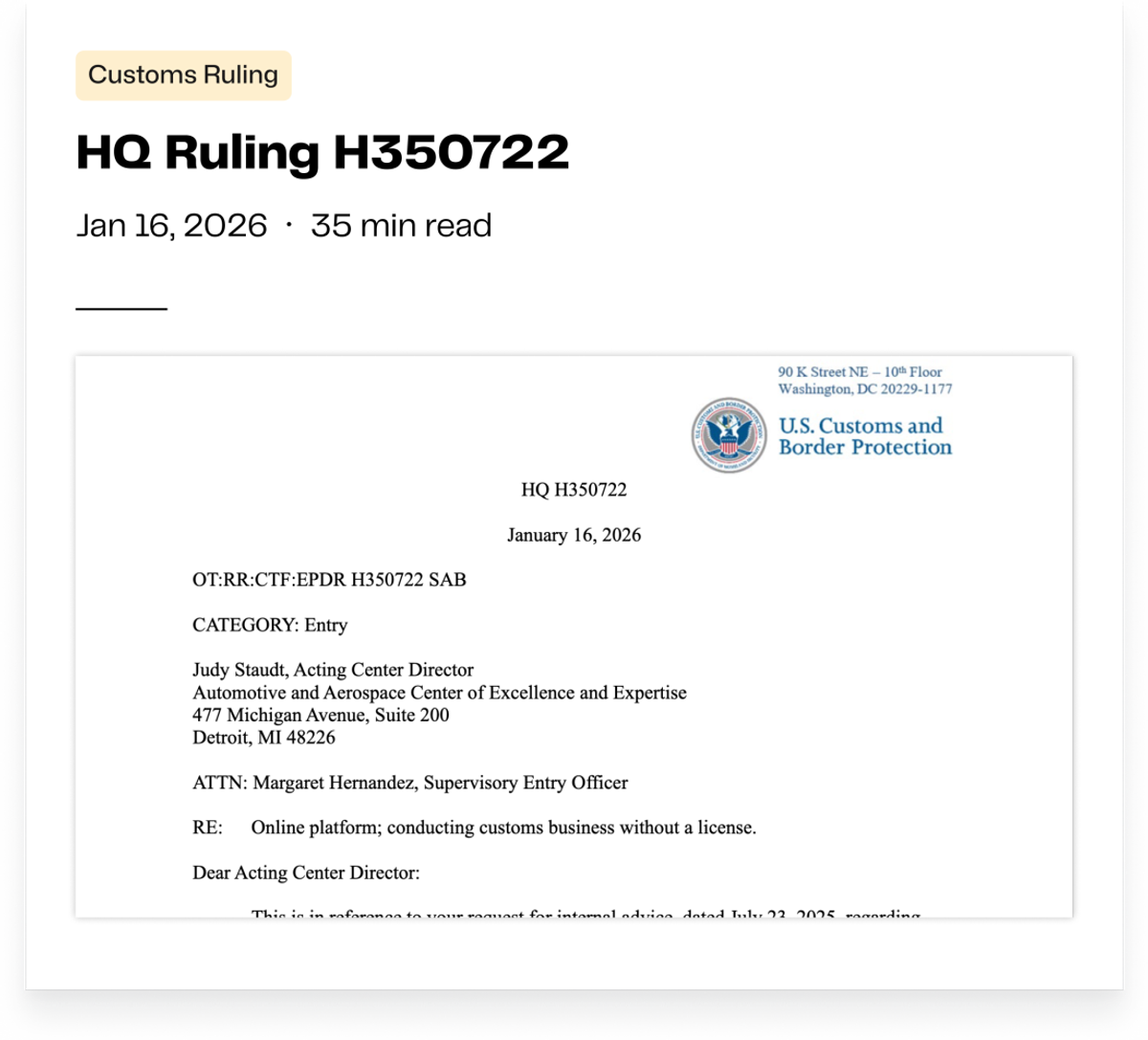
In 2026, a common instinct is to look at the ruling from January (released in March) - HQ ruling H350722 - which sent a shockwave through the technology providers, and the LCBs that use them. Personally, as a trade compliance junkie, I always felt this was a bit strange as from my seat, the ruling essentially asserted that:
- "Customs Business" is customs business, and can only be conducted by a Licensed Customs Broker
- Work on product data "in furtherance of an entry" is impermissible if conducted by an unlicensed entity - beyond mere transmission
- A simple disclaimer does not cure an unlicensed entity's noncompliance due to their undertaking of "customs business"
These were always my understanding, personally. The only patently "new" information I felt came from that ruling was the specific determination that OCR (automated document reading) is impermissible, which I believe opens the industry up to some significant risk of noncompliance very broadly based on what I see in the industry today.
One other interesting definition is about the ownership of the "decision matrix" which fundamentally assesses where the control and supervision exists. A licensed broker must have a significant role in specifying what information is automatically generated by any tool's decision matrix that produces entry-relevant output.
Of course, I am not a lawyer. However, I have had extensive conversations with top trade attorneys about this ruling. My take away substantially surrounds the fact that this ruling makes a big differentiation between data stored for purposes of a database vs. for advancing the preparation of entries.
Increasing enforcement
Increasing enforcement from CBP means brokers are battening down the hatches - it began already at least 6+ months ago.
It is commonly said that CBP was "behind" with technology for many years, all while volumes increased at an unprecedented rate and fraud followed along with it. I say this differently. I say that CBP was watching closely - collecting data, placing strategic resources and growing deep roots, all while up-skilling officers. They came into 2025 with a ready-to-go plan for enforcement:
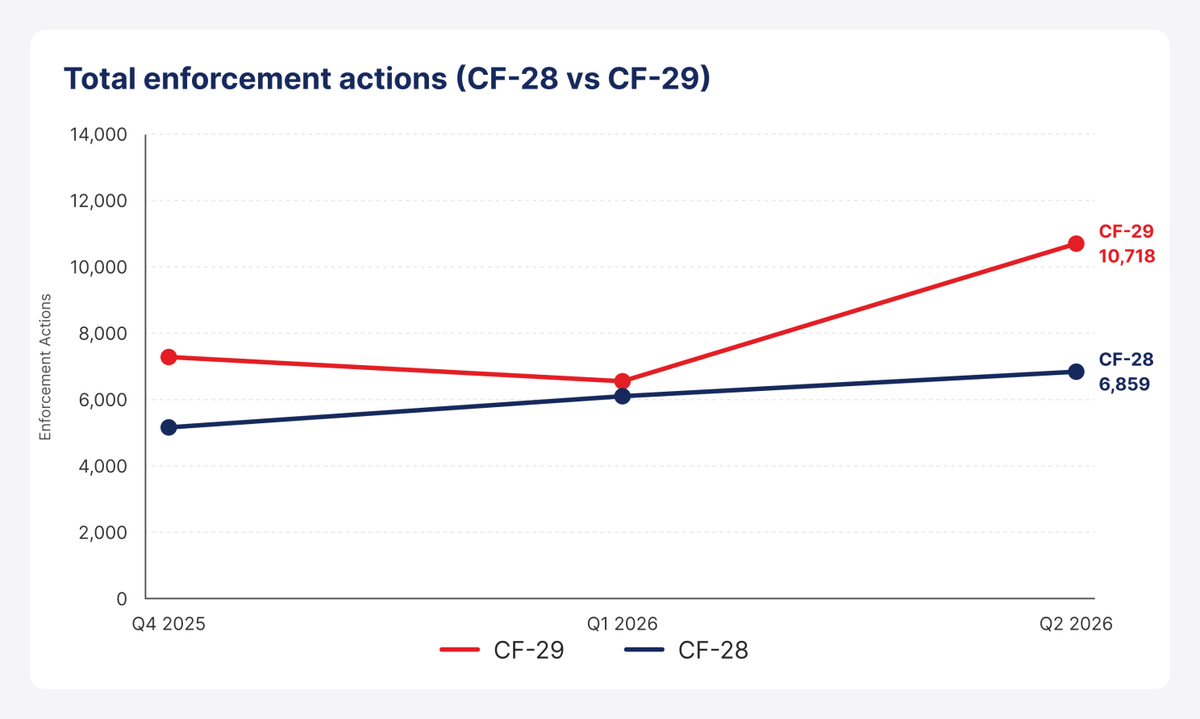
Q2 2026 demonstrates CBP's full capabilities - it was the highest quarterly total of customs inquiries since the Trump Administration began.
With enforcement taking hold so broadly, compliance has become front and center all over again. That doesn't just mean one-time compliance on your entry. Every entry is a potential hotspot for further customs scrutiny and enforcement - that means auditing and re-auditing your entries. Or even more importantly, getting your product master data compiled so that you are ready for audit and can minimize the effort to audit going forward.
Who is handling this change well?
While importers are breaking a sweat, who is really succeeding in this environment?
CBP. CBP is succeeding.
Their metrics have never been better: +5,057% ESF Recovery. +148% CF-29s issued.
Importers and brokerages that are feeling the stress and don't know what to do need to take a page out of the CBP playbook. You may never have a $3.5 Billion budget, but you don't need one. You need to see the kind of data analysis they're doing and replicate it, even on a small scale, so the issues CBP catch are actually caught earlier.
Where is this going?
Entries are getting more complex, the billing model of brokerage is shifting, and customers are measuring different things.
While release is important, post-entry work is becoming a bigger and bigger burden even for those who invest in quality entries upfront. The business model is changing - importers are getting smarter too.
Just because you can do a "cheap entry" doesn't mean you are delivering true customer success. Now you need to consider: what is the "all-in" cost of your entry, rather than the entry filing fee. I.e. include penalties, demurrage, cost of responding to CF-29s, extra fees assessed due to downstream noncompliance, and more. This is how importers are evaluating their entry preparation costs now.
Even more than ever before, your QBRs between broker<>importer matter to the longevity and the success of each and every relationship. Showing up to your QBR prepared, knowing the real challenges being faced by customers, and looking strategically at the unnecessary costs being invoiced month-to-month.
This is the era where success is determined by your ability to get 'back to basics':
- Classification: What is the product made of, who was involved in making it, and what is its intended use?
- Importer success: Understand your landed cost today, and have the ability to shift the data quickly. Assess the "all-in cost" of your entries.
- Data management: Get your master product database in order so you aren't reacting to every change.
- Enforcement: Leverage tooling that automates your 19 CFR obligations. Map and understand your 2nd and 3rd tier relationships. Diagnose the issues before CBP does.
- Cost management: Audit your process, your technology, and your people to understand the process bottlenecks.
We'll all come out the other side stronger and better for it.
This blog was originally posted in Trade Craft, by Hugo Pakula. You can subscribe here.
More from the blog
Oct 27, 2026
Solution Webinar: Tru Launches Importer Suite for Strategic Trade Compliance Teams
CBP enforcement is changing the cost of bad product data. See how Tru gives importers the control, visibility, and audit readiness to stay ahead.

Oct 6, 2026
Press Release: Jes Crownover Joins Tru as Head of Global Trade
Former FedEx and Livingston executive joins Tru to build the trade infrastructure for the future of imports.


©2026 Tru Identity, Inc. All rights reserved.