Event
Oct. 27th 12pm ET
Top 5 discussion topics from "19 CFR and AI" webinar with Cindy Allen and Hugo Pakula
By Tru Identity
Live on July 1, 2026 with Cindy Allen (TradeForce Multiplier) and Hugo Pakula (Tru Identity); follow both on LinkedIn for real-time trade insights and updates. Link to the full recording.
Trade compliance is changing fast: AI adoption, tariff volatility, and the end of de minimis all hit within the same stretch of time, and CBP used that window to close the technology gap. On this webinar, Cindy and Hugo gave a clear, actionable plan for trade professionals to keep pace with change while maintaining responsible supervision and control. Five takeaways stood out:
#1 The capability gap between CBP and industry has flipped, and is widening.
If you think AI is still something CBP is experimenting with, you're already behind.
CBP has spent decades building ACE into the largest repository of U.S. trade data, and AI is now layered directly on top of that infrastructure. Cindy estimated the private sector is roughly five to seven years behind the agency's current capabilities, and the gap continues to widen. The original ACE program was budgeted at $4 billion and ultimately cost about $5 billion to build. Now, CBP has another $3.5 billion committed through 2029 to expand AI-powered screening, anomaly detection, and historical trend analysis.
Cindy explained the targeting system with a simple analogy: it's the same risk assessment a parent makes when meeting their daughter's date. Who are they? What are they driving? What are they bringing with them? AI allows CBP to perform that same assessment across every commercial entry in seconds, relying on a massive dataset rather than instinct.
As Hugo pointed out: “CBP has technology. They have the technology to properly enforce all of the regulations they're responsible for, and that is a big burden…at the same time you need to be prepared to demonstrate your ability or your control over your practices, whether you're an importer or a customs broker, that is the must. There's no ifs, ands, or buts about it.”
What you can do now: Use this when you advocate for better resources and tools - it is great justification to your board or leadership that you cannot fight this battle alone, or the business at-large will "pay for it" both literally and metaphorically.
#2 Enforcement has been building for a decade. This isn't new, and it isn’t temporary.
Many companies are still treating today's enforcement environment as a short-term response to tariffs or recent executive orders.
Cindy made it clear that's the wrong way to think about it.
CBP has been getting serious about compliance for years through initiatives like the 21st Century Customs Framework, expanding ACE capabilities, and steadily increasing compliance expectations. The latest tariffs and executive actions didn't create this trend. They accelerated it.
The numbers tell the same story. Enforcement actions increased more than 500% in the years leading up to 2024 while e-commerce shipments exploded from hundreds of thousands of entries to roughly 1.8 billion annually. Eliminating de minimis didn't eliminate that volume. It converted much of it into formal commercial entries, giving CBP even more data to analyze with increasingly sophisticated AI tools.
As Hugo noted during the discussion, compliance has historically moved in one direction: always more, never less. Requirements increase, enforcement expands, and the organizations that adapt early are the ones best positioned when the next wave arrives.
Why this matters: Recognizing that you have a problem is the first step towards solving it. This problem is real, it is current, and it is permanent. If you haven't yet decided what your approach to enforcement-readiness, or rather audit-readiness, will be with technology, then the best time to do it is right now. It will only get harder from here.
#3 The question isn't if to use AI. It’s how to use it, responsibly.
Neither speaker suggested AI replaces customs expertise. Instead, both argued the opposite.
Cindy compared AI to technologies like ABI, ACE, Excel, or automated classification software. They're tools that make professionals more effective, not substitutes for 19 CFR obligations or professional judgment. The responsibility for the outcome still belongs to the customs broker or importer.
Hugo emphasized that responsible AI means maintaining documented processes, reviewing outputs, understanding how recommendations are generated, and being able to explain those decisions during an audit. As CBP's own AI capabilities continue to improve, that level of documentation and oversight becomes increasingly important.
The firms that succeed won't be the ones using the most AI, or the least AI. They'll be the ones that can prove they used it responsibly under increasing scrutiny.
Why this matters: AI is not something to be scared of - it is a tool, much like those of prior periods of innovation. With AI being adopted on all sides - importers, freight forwarders, and importantly even U.S. Customs - it is critical that customs brokers adopt AI to maintain scalability and readiness at least at the same pace as their counterparts.
#4 AI raises the standard. It doesn't replace the licensed customs broker.
One of the biggest misconceptions surrounding AI is that it changes who is legally allowed to perform customs business.
It doesn't. Responsible supervision and control is still the standard.
As Hugo Pakula explained, HQ Ruling H350722 didn’t create a new framework for AI; rather, It clarified that existing customs brokerage rules still apply. If broker business is being performed, licensed customs broker oversight is still required. AI can help audit and enrich data, triage review, and continuously monitor for trade updates, but it cannot replace the legal responsibilities of an LCB.
Cindy also highlighted another challenge: recent executive orders expect customs brokers to act as compliance watchdogs, even though brokers don't control importer behavior. Cindy’s take: “Sometimes they want to put us in that enforcement environment, and we don't have the tools, we don't have the expertise, we don't have the authority to ask these questions. We can ask them, but they don't have the requirement to answer us.”
AI cannot eliminate that dynamic, but it can help brokers demonstrate the oversight, review, and documentation CBP increasingly expects to see.
What you can do now: Evaluate vendors against a consistent playbook that is aligned with your business needs - specifically, ensuring you rule out vendors who don't understand their compliance obligations or the regulatory landscape they operate in. They should be able to articulate their standing in the face of Ruling 722.
#5 Ironically, AI is bringing trade compliance back to the fundamentals, just with much greater visibility.
AI sophistication doesn’t change what actually protects an importer or broker; it just makes it much less possible to shortcut the basics. Here’s what matters:
Back to basics #1: the product
Hugo put it plainly: "What matters more than ever is 1) what is the product. 2) Where does it come from? 3) What is it made of?" That's the standard generic e-commerce entries have failed to meet, extending past your own four walls: "Do you know your second or third tier, or do you just have a trading company you work with?" Cindy cited precedent: Section 232 forced every ABI system to be rebuilt to capture steel and aluminum origin data. She worries the executive order pushes CBP toward that depth well beyond 232 and 301.
Back to basics #2: the importer-broker relationship
Hugo sees this as where brokers differentiate in an AI-saturated market: "the way that brokers differentiate is by really having that relationship, knowing their data, being close to them, being a real service provider, not just a data pusher." A tool can process an entry; it can't build trust. The relationship carries weight technology can't replace.
Back to basics #3: use technology to solve real problems
Cindy's advice: "the first thing you should ask is, what problem am I trying to solve?" Scattered data, illegible invoices, and CBP-facing communication need different tools, not one blanket AI purchase. Hugo added that internal alignment matters just as much: "Do you have a shared definition of success at your company? ... Don't get distracted by shiny objects." His litmus test: have they solved this exact problem before?
What you can do now: Evaluate your process and define success criteria across each stakeholder in the business. Understand which specific parts of the workflow that touches customer data, entry data, or product data will need to be accommodated with AI. Having this information in hand sets you up for success when you start the process of implementation.
_____________________________________________________________________________________________________
CBP isn't the only one with access to advanced tooling. Our partnership with CBP puts the same screening and anomaly-detection technology directly into your compliance workflow so you're seeing what CBP sees, before they flag it for you. Join the program →
More from the blog
Oct 27, 2026
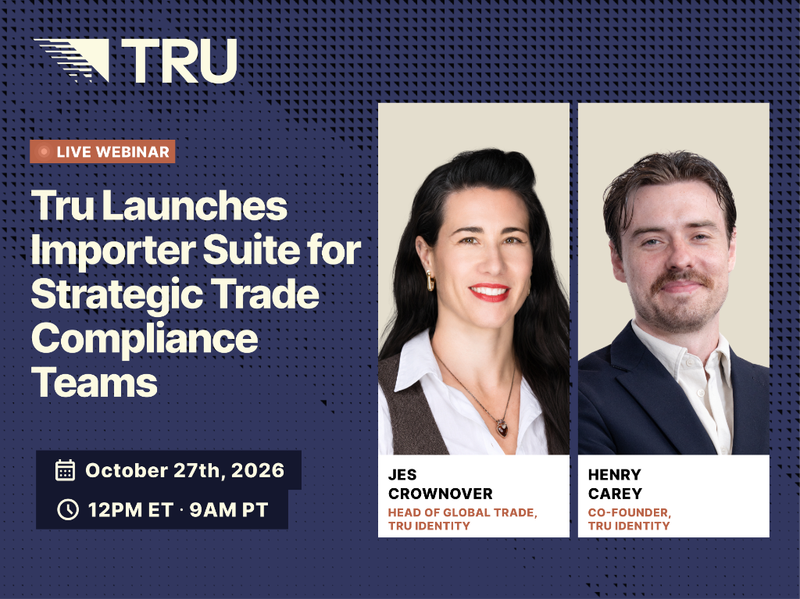
Solution Webinar: Tru Launches Importer Suite for Strategic Trade Compliance Teams
CBP enforcement is changing the cost of bad product data. See how Tru gives importers the control, visibility, and audit readiness to stay ahead.
Oct 6, 2026
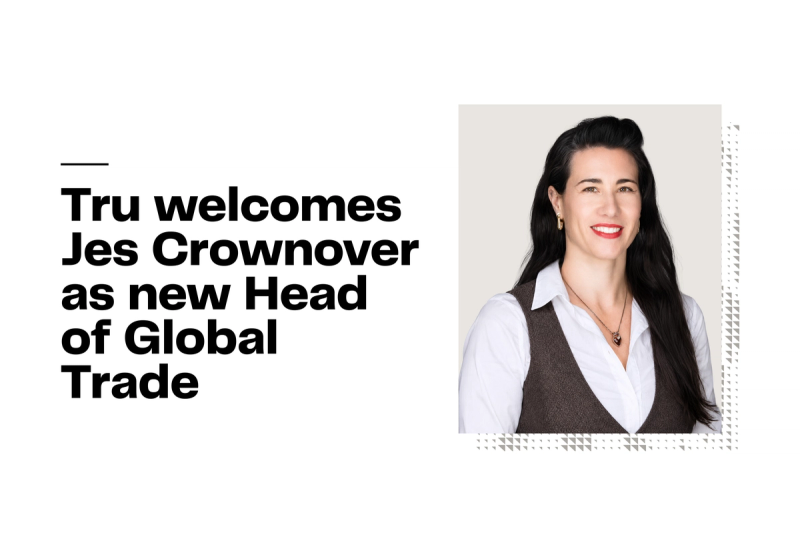
Press Release: Jes Crownover Joins Tru as Head of Global Trade
Former FedEx and Livingston executive joins Tru to build the trade infrastructure for the future of imports.


©2026 Tru Identity, Inc. All rights reserved.