
Oct 6, 2026
Press Release: Jes Crownover Joins Tru as Head of Global Trade
Former FedEx and Livingston executive joins Tru to build the trade infrastructure for the future of imports.
Event
OCT. 27th 12:00 PM ET
By Hugo Pakula · Oct 19, 2026
This article was originally published on LinkedIn in Hugo Pakula’s Trade Craft newsletter.
CBP has said it directly: if you are a bad broker or a bad importer, expect scrutiny. That language naturally makes people think about fraud, but the more common problem is usually less dramatic and much harder to deal with. An importer may have product information scattered between a purchasing system, old invoices, supplier specifications, and someone’s inbox, while the broker receives a commercial invoice that does not contain enough information to support the decision being made. By the time that information reaches the entry, a lot of the context has already been lost.
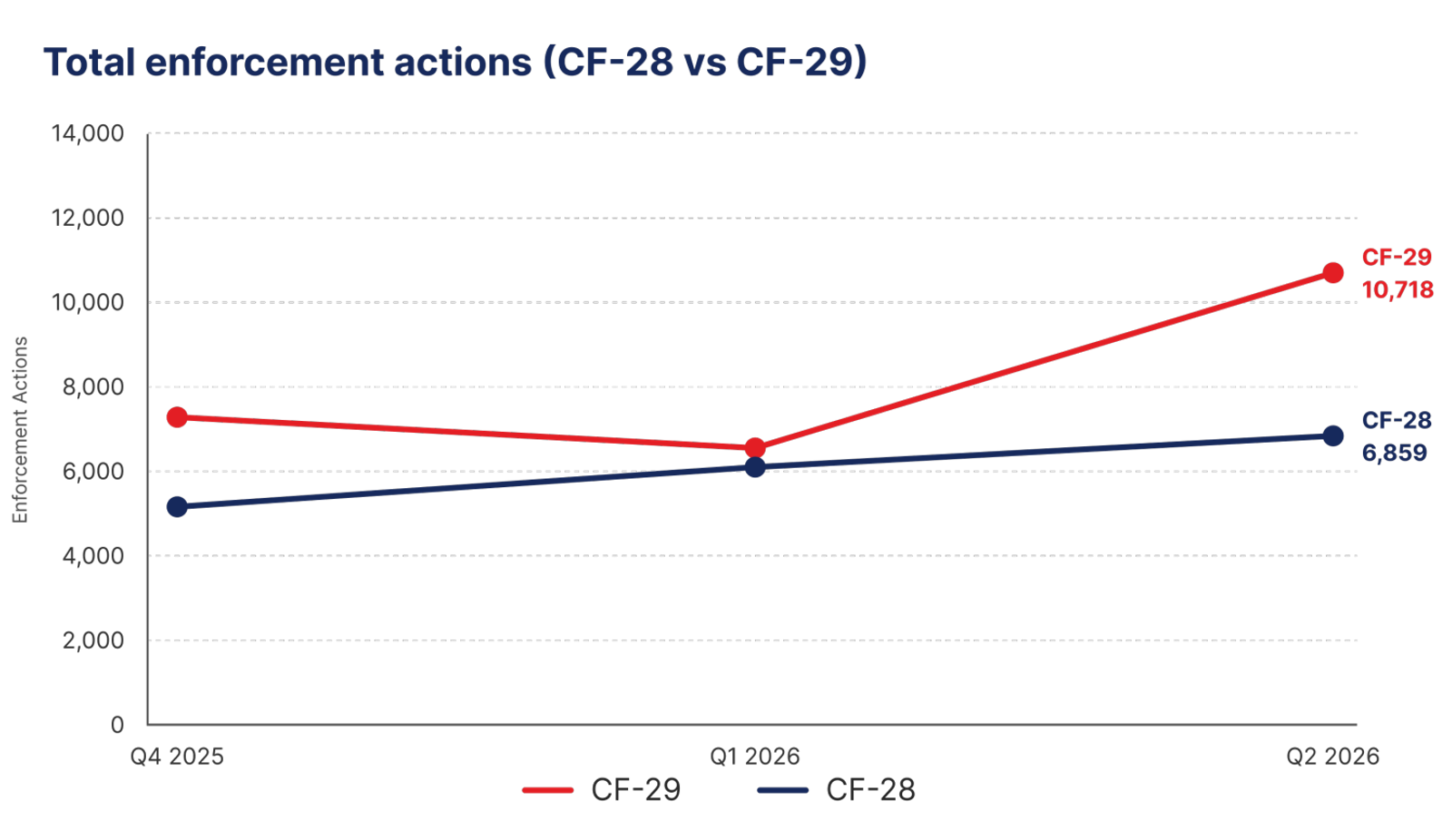
This is where the environment has changed. Complexity has gone up, enforcement has gone up with it, and CBP is looking at entry data in a way that gives it a better picture of how an importer or broker operates. Tru Identity’s Q2 enforcement report shows that CF-28s are staying flat, while CF-29s are increasing, signaling that CBP has more confidence in its audits.
Importers must exercise reasonable care over the classification, valuation, country of origin, PGA information, antidumping and countervailing duty exposure, and every other piece of information declared to CBP. Brokers have a different obligation: responsible supervision and control over the process used to prepare and file those entries. The distinction matters because the importer cannot simply hand over a set of documents and assume that the broker has taken on the entire compliance obligation.
In United States v. Golden Ship Trading Co. (CIT, 2001), Judge Barzilay wrote that “relying on the exporter and the broker did not remove the importer’s duty of reasonable care.” That is a difficult message for an importer to hear, particularly when a broker is the one filing the entry. The importer needs to understand the information being declared in its name and needs to be able to support it when questions arise, while still being a step removed from the entry.
Brokers are in a difficult position too. Under § 1641(b)(4), they must exercise responsible supervision and control, now measured by the 13 factors CBP adopted into the regulations in 2022. They are expected to maintain a process that can handle incomplete information, identify problems, and document the work being done, even though the underlying information starts with the importer and its suppliers.
When something goes wrong, it is rarely as simple as saying that one side failed and the other did not. More often, the data did not make it through the relationship in a form that could support a compliant entry.
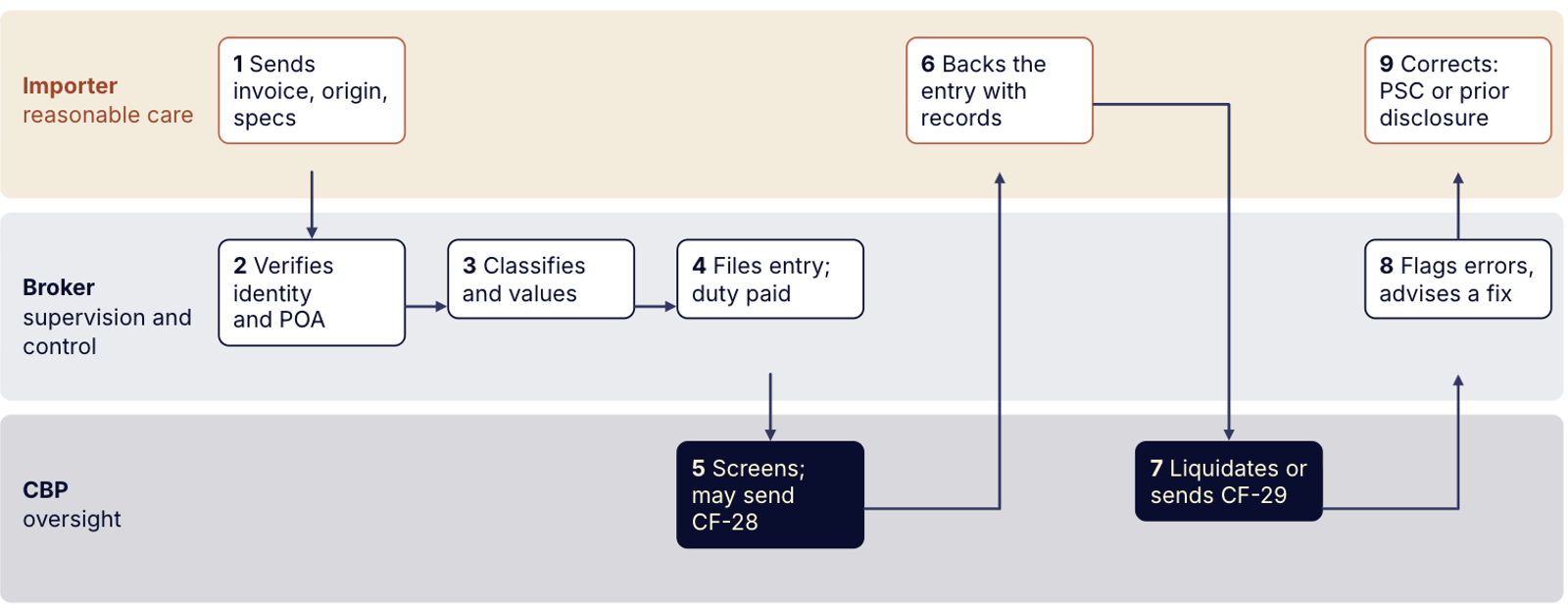
CBP sees the declaration and the history around it. CBP does not see the supplier that changed a description at the last minute, the person who did not answer an email, or the internal conversation where someone decided that an entry line was probably the same product as last time. Instead, what CBP can see is whether similar products are being entered consistently, whether the valuation makes sense, whether the same issues keep appearing, and whether an importer’s filings line up with its own history.
That is why so much compliance work becomes post-entry work. Issues may be resolved in PSCs, but the underlying source of the problem has not changed, so it appears again with another product, another supplier, or another broker.
This is the kind of pattern that is hard for an individual entry writer to see while managing day-to-day volume, but it is exactly the kind of pattern that becomes visible when somebody looks across the entire entry history.
This is the level of intelligence that CBP is now bringing to the table for enforcement, largely due to Executive Order 14411, “Strengthening Customs Enforcement.”
Importers should care about what an entry costs, but the filing fee alone does not tell them much about the total cost of the relationship. It does not tell them whether their broker is seeing the same classification issue repeatedly, whether the product data is getting worse as it moves through the supply chain, or whether the business will be able to explain a decision when a CF-28 or CF-29 arrives months later. That is why the idea of a “cheap entry” is becoming harder to defend. A customs broker may be able to process and file the entry at a low price, but that is different from helping the importer understand its data, improve the process behind the entry, identify recurring risks, and avoid work that will otherwise come back later as a correction or enforcement issue. Importers are beginning to look at this more closely because the combined cost of tariffs, post-entry work, and being wrong has become too significant to ignore.
There is a commercial challenge here for brokerages. Customers expect speed and low prices, while also expecting help with tariff changes, classifications, refund opportunities, product data, audits, and downstream questions from CBP.
Those expectations are not going away, and they cannot be met just by asking entry writers to work faster or remember more information. The process itself has to improve.
There are three audits you can do right now.
The first place to start is accuracy. An importer and broker should be able to look at the classification, description, valuation, PGA information, and trade-remedy treatment on an entry and connect each part back to the actual product and supporting information. That does not require a full investigation of every line every time, but it does require enough structure that the business can tell the difference between a supported decision and one that merely seemed reasonable at the time.
Consistency is the next issue, and it is often where the more interesting problems appear. A company may have individually defensible entries and product data that looks completely innocuous on the micro level but is actually inconsistent across its product catalog, particularly when it has multiple suppliers, multiple brokers, or product descriptions that change from shipment to shipment. Looking across that data can show where the same product is being treated differently, where a supplier is consistently creating poor information, or where a broker is relying on an assumption that does not hold up elsewhere in the business.
The third angle is opportunity. Once the data is accurate and consistent, importers can begin to see whether they are overpaying duties or missing refund opportunities. This is the part of compliance work that often gets missed when the entire organization is focused on fixing yesterday’s entry. Better data does not only reduce exposure; it also gives the business a clearer view of where money is being left on the table.
CBP has a $3.5B enforcement budget, a long history of entry data, and a much clearer sense of where it wants to focus than it did a few years ago. Importers and brokerages do not need to replicate CBP’s program, but they do need to understand the information behind their own entries well enough to find the obvious gaps before someone else does.
For importers, that means getting product data into a form that can actually be used for customs decisions rather than leaving it spread across vendors, purchase orders, invoices, and internal systems. For brokers, it means building processes that do more than turn documents into entries; they need to help identify uncertainty, maintain consistency, and show the basis for the decisions being made. The importer still owns the data, and the broker still owns the process, but neither obligation works very well without the other.
Oct 6, 2026
Press Release: Jes Crownover Joins Tru as Head of Global Trade
Former FedEx and Livingston executive joins Tru to build the trade infrastructure for the future of imports.

Oct 6, 2026
Q&A with Jes Crownover: Why I Joined Tru
Jes Crownover discusses why trade compliance's future belongs to those who combine expertise with technology.
Oct 1, 2026
The Data Behind Every CAPE Refund
For eligible importers, IEEPA refunds create a meaningful opportunity to recover money. But CBP is not issuing those refunds based on a high-level evaluation. It is reviewing the entry data behind every claim.

©2026 Tru Identity, Inc. All rights reserved.